Buy mobilesolution.eu ?
We are moving the project
mobilesolution.eu .
Are you interested in purchasing the domain
mobilesolution.eu ?
domain@kv-gmbh.de · 0541-91531010
Buy mobilesolution.eu ?
Can economic efficiency and productivity develop mutually?
Yes, economic efficiency and productivity can develop mutually. When businesses and industries become more efficient in their operations, they can produce more output with the same amount of input, leading to increased productivity. Similarly, when productivity increases, it can drive economic efficiency by reducing waste and improving resource allocation. Therefore, as businesses and industries focus on improving efficiency and productivity, they can reinforce and support each other's development. **
What does 3rd person singular and 3rd person plural mean?
In grammar, the 3rd person singular refers to a single individual or thing, while the 3rd person plural refers to a group of individuals or things. In English, the 3rd person singular pronouns include "he," "she," "it," and "one," while the 3rd person plural pronouns include "they" and "them." When using verbs, the 3rd person singular form typically ends in "s" or "es," while the 3rd person plural form does not have any additional endings. Understanding the difference between 3rd person singular and 3rd person plural is important for maintaining subject-verb agreement in sentences. **


Similar search terms for 3rd
Top-Angebote
Products related to 3rd:
-
SAGE Publications The Complete Handbook of Coaching, 3rd EditionThis book provides a wide-ranging guide to the complex, multidisciplinary area of coaching, helping trainees to find comprehensive answers to their coaching questions. It allows them to identify and develop their own personal style of coaching.A specially selected group of international authors contribute various expertise and insights across three key areas: Theoretical perspectives Contexts and genres of coaching Professional practice Issues Learning is also supported by new online resources. Videos, case studies, journal articles and useful websites have been carefully collated by our contributors to help trainees make the crucial link between theory and practice.26,99 £*Shipping: 2,99 £Secure redirect to the provider
-
All Categories Goods Black LED 3rd Brake Light, High Brightness Cargo Lamp, Waterproof Black LED 3rd Brake Light, High Brightness Cargo Lamp, WaterproofHighQuality LED 3rd Brake Light Enhance your vehicles safety and style with this LED 3rd brake light. Designed to deliver superior visibility, this brake light ensures that you remain visible even in harsh weather conditions. Its waterproof IP67...69,97 $*Shipping: 0,00 $Secure redirect to the provider
-
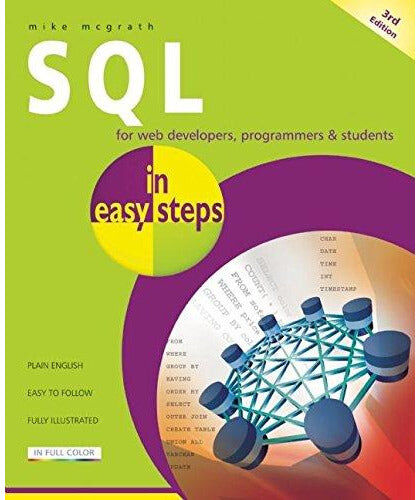
In Easy Steps Limited SQL In Easy Steps 3rd EditionSQL in easy steps, 3rd edition has an easy-to-follow style that will appeal to anyone who wants to begin using databases. It is aimed at those with little or no experience of SQL. From web developers wanting to add database interaction to their web sites, programmers wanting to quickly add SQL to their skills set, hobbyists who want to begin creating SQL scripts for upload to their own ISP, to students or to those seeking a career in computing, this book will appeal to all who need a fundamental understanding of database administration with SQL. SQL in easy steps, 3rd edition begins by explaining how to download and install the free MySQL database server on both Windows and Linux platforms. This allows you to establish an environment in which to develop and administer your own databases. This book makes no assumption that you will have previous knowledge of any programming or scripting language so it's ideal for the newcomer to SQL. Each chapter builds your knowledge of executing database queries. The book contains exciting chapters on how to selectively extract data from within one, or more, databases and there are complete examples that illustrate each aspect of SQL. By the end of this book you will have gained a sound understanding of the Structured Query Language and be able to write your own SQL scripts to insert, extract and manipulate data. Updated and revised with the latest techniques since the second edition, which was published in 2005. All examples given in this 3rd edition demonstrate SQL features using the MySQL Relational Database Management System that is supported on both Windows and Linux operating systems. Table of Contents Introducing SQL Getting Started Creating database tables Inserting data into tables Retrieving data from tables Sorting retrieved data Simple data filtering Complex data filtering Generating calculated fields Manipulating data Grouping table data Making complex queries Joining database tables5,49 £*Shipping: 2,99 £Secure redirect to the provider



-
What is the difference between efficiency and productivity?
Efficiency refers to how well resources are utilized to achieve a specific goal or output, while productivity measures the output or results generated from a specific amount of input or resources. Efficiency focuses on minimizing waste and maximizing output with the resources available, while productivity is a measure of how much output is produced relative to the input used. In essence, efficiency is about doing things right, while productivity is about doing the right things. **
-
What are the connections between efficiency and productivity?
Efficiency and productivity are closely connected in that efficiency refers to the ability to accomplish a task with minimal waste, effort, or cost, while productivity refers to the rate at which goods or services are produced. When a process or system is efficient, it can lead to increased productivity because it allows for more output to be generated with the same amount of input. Conversely, when productivity is high, it often indicates that the resources and processes are being used efficiently. Therefore, improving efficiency can lead to increased productivity, and vice versa, as they both contribute to the overall effectiveness of a business or organization. **
-
Does increasing productivity lead to higher economic efficiency?
Yes, increasing productivity can lead to higher economic efficiency. When a company or economy can produce more output with the same input of resources, it can lead to lower production costs and higher profits. This can also lead to lower prices for consumers, which can increase overall economic welfare. Additionally, higher productivity can lead to increased competitiveness in the global market, which can further contribute to economic efficiency. **
-
What is the 3rd?
The 3rd is the ordinal number that comes after the 2nd and before the 4th in a sequence. It is used to denote the position of an item in a list or series. In mathematics, the 3rd is also used to refer to the third element in a set or sequence. **


What does 3rd mean?
In the context of a sequence or ranking, "3rd" refers to the position that comes after the first and second positions. It indicates that something is in the third place or is the third item in a series. For example, in a race, the person finishing in 3rd place is the third fastest runner. **
What is the difference between productivity, efficiency, and profitability?
Productivity refers to the amount of output produced per unit of input, such as time or resources. Efficiency, on the other hand, focuses on how well resources are used to achieve a specific goal or output. Profitability, meanwhile, is a measure of how efficiently a company generates profit relative to its costs and expenses. In essence, productivity is about output per input, efficiency is about resource utilization, and profitability is about the bottom line of a business. **
Top-Angebote
Products related to 3rd:
-
Scholastic 3rd Grade Family & Friendship Value PackThe bonds of friendship and family are explored in these four stories from bestselling middle grade authors.This set includes:11 BirthdaysThe Baby-Sitters Club #1: Kristy's Great IdeaNot Your All-American GirlYou Don't Know Everything, Jilly P! 3rd...26,99 $*Shipping: 0,00 $Secure redirect to the provider
-
Apple AirPods 3rd Gen White MagSafe - RefurbishedNote: All in-ear components have either been thoroughly cleaned and fully sterilized or replaced with new ones. The third generation refurbed Apple AirPods fit perfectly into your ear, just like the previous generations, thanks to their contoured fit. They are, however, 33% shorter at the end in comparison to the second generation AirPods. How do the refurbed 3rd generation Apple AirPods work? They work as per usual via the force sensor. Press once to play or pause audio or answer a call. Press twice and the next track will play. Press three times to play the previous track. For voice control, hold down the force sensor and say “Hey Siri” and your personal assistant will activate and be ready for your commands. 3D audio for an immersive sound experience Whether it’s for music or movies, the completely refurbished 3rd generation Apple AirPods boast spatial audio and dynamic head tracking. It will always feel like you’re directly in the heart of a song or movie scene. A setup as easy as ABC The refurbed 3rd generation Apple AirPods are extremely easy to charge – just place them in their charging case. Perfect for when you’re in a hurry as a mere 5 minutes in the charging case can mean approximately 1 hour’s worth of listening and talking time. In order to use them, all you do is take the AirPods out of their case and connect them to your Apple device via Bluetooth. Just like that, you’ll be well on your way to a high-quality sound experience like no other.92,00 £*Shipping: 0,00 £Secure redirect to the provider
-
SAGE Publications The Complete Handbook of Coaching, 3rd EditionThis book provides a wide-ranging guide to the complex, multidisciplinary area of coaching, helping trainees to find comprehensive answers to their coaching questions. It allows them to identify and develop their own personal style of coaching.A specially selected group of international authors contribute various expertise and insights across three key areas: Theoretical perspectives Contexts and genres of coaching Professional practice Issues Learning is also supported by new online resources. Videos, case studies, journal articles and useful websites have been carefully collated by our contributors to help trainees make the crucial link between theory and practice.26,99 £*Shipping: 2,99 £Secure redirect to the provider
-
All Categories Goods Black LED 3rd Brake Light, High Brightness Cargo Lamp, Waterproof Black LED 3rd Brake Light, High Brightness Cargo Lamp, WaterproofHighQuality LED 3rd Brake Light Enhance your vehicles safety and style with this LED 3rd brake light. Designed to deliver superior visibility, this brake light ensures that you remain visible even in harsh weather conditions. Its waterproof IP67...69,97 $*Shipping: 0,00 $Secure redirect to the provider
-
Can economic efficiency and productivity develop mutually?
Yes, economic efficiency and productivity can develop mutually. When businesses and industries become more efficient in their operations, they can produce more output with the same amount of input, leading to increased productivity. Similarly, when productivity increases, it can drive economic efficiency by reducing waste and improving resource allocation. Therefore, as businesses and industries focus on improving efficiency and productivity, they can reinforce and support each other's development. **
-
What does 3rd person singular and 3rd person plural mean?
In grammar, the 3rd person singular refers to a single individual or thing, while the 3rd person plural refers to a group of individuals or things. In English, the 3rd person singular pronouns include "he," "she," "it," and "one," while the 3rd person plural pronouns include "they" and "them." When using verbs, the 3rd person singular form typically ends in "s" or "es," while the 3rd person plural form does not have any additional endings. Understanding the difference between 3rd person singular and 3rd person plural is important for maintaining subject-verb agreement in sentences. **
-
What is the difference between efficiency and productivity?
Efficiency refers to how well resources are utilized to achieve a specific goal or output, while productivity measures the output or results generated from a specific amount of input or resources. Efficiency focuses on minimizing waste and maximizing output with the resources available, while productivity is a measure of how much output is produced relative to the input used. In essence, efficiency is about doing things right, while productivity is about doing the right things. **
-
What are the connections between efficiency and productivity?
Efficiency and productivity are closely connected in that efficiency refers to the ability to accomplish a task with minimal waste, effort, or cost, while productivity refers to the rate at which goods or services are produced. When a process or system is efficient, it can lead to increased productivity because it allows for more output to be generated with the same amount of input. Conversely, when productivity is high, it often indicates that the resources and processes are being used efficiently. Therefore, improving efficiency can lead to increased productivity, and vice versa, as they both contribute to the overall effectiveness of a business or organization. **
Similar search terms for 3rd
-
In Easy Steps Limited SQL In Easy Steps 3rd EditionSQL in easy steps, 3rd edition has an easy-to-follow style that will appeal to anyone who wants to begin using databases. It is aimed at those with little or no experience of SQL. From web developers wanting to add database interaction to their web sites, programmers wanting to quickly add SQL to their skills set, hobbyists who want to begin creating SQL scripts for upload to their own ISP, to students or to those seeking a career in computing, this book will appeal to all who need a fundamental understanding of database administration with SQL. SQL in easy steps, 3rd edition begins by explaining how to download and install the free MySQL database server on both Windows and Linux platforms. This allows you to establish an environment in which to develop and administer your own databases. This book makes no assumption that you will have previous knowledge of any programming or scripting language so it's ideal for the newcomer to SQL. Each chapter builds your knowledge of executing database queries. The book contains exciting chapters on how to selectively extract data from within one, or more, databases and there are complete examples that illustrate each aspect of SQL. By the end of this book you will have gained a sound understanding of the Structured Query Language and be able to write your own SQL scripts to insert, extract and manipulate data. Updated and revised with the latest techniques since the second edition, which was published in 2005. All examples given in this 3rd edition demonstrate SQL features using the MySQL Relational Database Management System that is supported on both Windows and Linux operating systems. Table of Contents Introducing SQL Getting Started Creating database tables Inserting data into tables Retrieving data from tables Sorting retrieved data Simple data filtering Complex data filtering Generating calculated fields Manipulating data Grouping table data Making complex queries Joining database tables5,49 £*Shipping: 2,99 £Secure redirect to the provider
-
Clesse BP2403 37mbar 3rd Stage Propane Regulator with UPSO 12kg/hrThe Clesse BP2403 37mbar 3rd Stage Propane Gas Regulator. This robust regulator is designed for reliable pressure control and is perfect for applications requiring a consistent 12kg/h flow rate. The BP2403 ensures optimal performance with inlet pressures ranging from 60-90 mbar. Equipped with an LRV (Pressure Relief Valve), the Clesse BP2403 offers added safety by preventing over-pressurization, ensuring your setup operates safely at all times. The regulator also features an UPSO (Under Pressure Shut Off) mechanism that is easily monitored through a transparent cap. This feature allows for quick checks and effortless resetting via a convenient pull tab, making maintenance straightforward and stress-free. The BP2403 is designed with the user in mind. A rotatable vent cover provides flexible installation options, allowing you to position the regulator in the most conveni226,04 £*Shipping: 0,00 £Secure redirect to the provider
-
Does increasing productivity lead to higher economic efficiency?
Yes, increasing productivity can lead to higher economic efficiency. When a company or economy can produce more output with the same input of resources, it can lead to lower production costs and higher profits. This can also lead to lower prices for consumers, which can increase overall economic welfare. Additionally, higher productivity can lead to increased competitiveness in the global market, which can further contribute to economic efficiency. **
-
What is the 3rd?
The 3rd is the ordinal number that comes after the 2nd and before the 4th in a sequence. It is used to denote the position of an item in a list or series. In mathematics, the 3rd is also used to refer to the third element in a set or sequence. **
-
What does 3rd mean?
In the context of a sequence or ranking, "3rd" refers to the position that comes after the first and second positions. It indicates that something is in the third place or is the third item in a series. For example, in a race, the person finishing in 3rd place is the third fastest runner. **
-
What is the difference between productivity, efficiency, and profitability?
Productivity refers to the amount of output produced per unit of input, such as time or resources. Efficiency, on the other hand, focuses on how well resources are used to achieve a specific goal or output. Profitability, meanwhile, is a measure of how efficiently a company generates profit relative to its costs and expenses. In essence, productivity is about output per input, efficiency is about resource utilization, and profitability is about the bottom line of a business. **
* All prices are inclusive of VAT and, if applicable, plus shipping costs. The offer information is based on the details provided by the respective shop and is updated through automated processes. Real-time updates do not occur, so deviations can occur in individual cases. ** Note: Parts of this content were created by AI.